
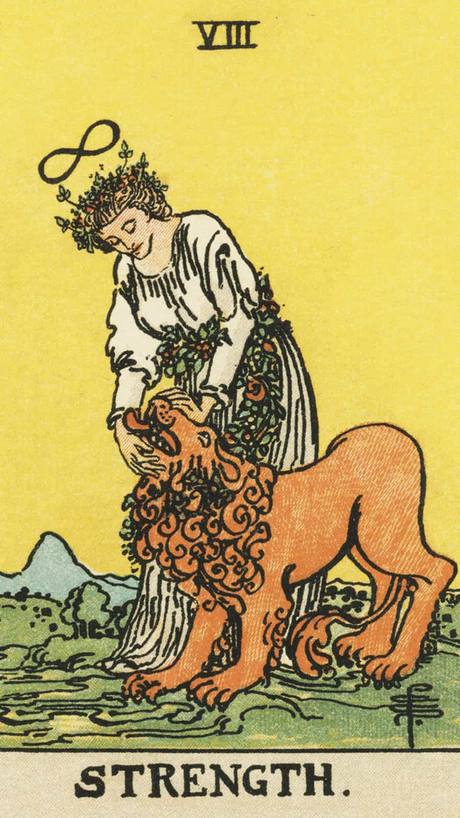
Strength
Courage, Patience, Compassion.
Strength describes courage expressed through patience and steady attention. It invites you to work with strong feelings or difficult situations without assuming that force, suppression, or immediate victory is the only way forward.
Upright Keywords
Reversed Keywords
Meanings at a Glance

Love & Relationships 
Meet tension with honesty and steadiness. Compassion can help you listen, while a clear boundary protects you from accepting behavior that repeatedly harms the connection.

Career & Work
Handle a challenge through persistence, preparation, and measured communication. Calm leadership can be more effective than increasing pressure when people are already strained.

Personal Growth
Build trust in your ability to respond to discomfort. You can acknowledge a strong emotion and still choose how to act on it.
Strength: A Deeper Reading
Card Imagery & Symbolism
A woman gently holds a lion's jaws beneath an infinity sign. Her posture appears calm, and a garland connects the figures. The lion evokes instinct and powerful emotion, while her attentive approach suggests a relationship with that energy rather than its destruction.
What to Notice
Notice the absence of a weapon. What could change if you approached the difficulty with steadiness instead of a contest of force?
Understanding the Meaning
Core Symbolism
Courage can be quiet, patient, and clear about its limits.
Upright, Strength points to resilience, emotional steadiness, and compassionate self-control. It can appear when you need to stay engaged with something difficult without reacting automatically.
Patience does not require endless endurance. A strong response may include asking for support, stating a boundary, or choosing to step away from an unproductive interaction.
A Reflective Perspective
Reflect on what you call weakness. Needing time, feeling afraid, or requesting help may be compatible with acting courageously. Consider whether harshness toward yourself is making a challenge harder to face.
Questions to Consider
- Which feeling needs acknowledgment before I act?
- What would a firm and compassionate response look like?
- Where would support help me stay steady?
Everyday Guidance
Love & Relationships
Strength in a relationship reading can invite patience without asking you to hide what matters. If a disagreement keeps returning, name one specific concern during a calm moment and explain what you need. Notice whether both people can listen and participate. With reversed Strength, consider whether your apparent calm comes from steadiness or from holding feelings inside until frustration builds. If you already communicate clearly but feel worn down by carrying the discussion alone, a boundary or support may be more useful than further endurance.
Career & Work
Prepare for a difficult conversation with specific observations and a practical request. Persist with a demanding task in manageable intervals. Avoid treating overwork as the only evidence of commitment.
Personal Growth
Practice noticing an emotion without immediately obeying or rejecting it. A short pause can create room for a considered response. Record moments when you acted with steadiness, including times when you asked for help.
Reversed Meaning
Reversed, Strength can highlight difficulty accessing confidence, patience, or emotional steadiness. This may appear as doubting yourself, suppressing feelings, or trying so hard to remain in control that you become exhausted. These possibilities are not interchangeable: look at how you are responding to the situation and what the card’s position asks you to explore. Reversed Strength does not automatically mean weakness or defeat.
Self-doubt
A setback may be shaping your view of your overall ability. Compare the thought “I cannot handle this” with what you have managed before and what support is available now. The useful question is whether confidence needs rebuilding, rather than whether one difficult moment defines you.
Suppression
Appearing calm is not always the same as feeling steady. If you repeatedly say that everything is fine while your needs remain unspoken, the card can invite more honest expression. Identify one feeling or concern you can communicate clearly without expecting it to resolve the entire situation.
Overexertion
You may be treating constant endurance as proof of strength. Notice whether you are taking on more than you can realistically sustain or refusing help because you feel you should cope alone. Rest, shared responsibility, or a clearer limit may help restore steadiness.
Reactivity
Strong feelings may be narrowing the space between an event and your response. If you answer quickly and later wish you had paused, consider what would give you time to choose your words. The aim is to acknowledge the feeling while deciding how to act on it.
Advice for Your Reading
Respond to the challenge with patience, a clear limit, and the support you need.
Look for the smallest action that helps you regain steadiness. The aim is to make a workable response possible, even if the difficulty does not disappear immediately.
Symbolism, Context & Common Questions
Why this imagery matters
Waite describes a woman guiding a lion with a chain of flowers. The image contrasts restraint and gentleness with physical force. Taku’s modern reflection below uses that contrast; it is not a literal prediction.
Historical reference: A. E. Waite, The Pictorial Key to the Tarot.
What does Strength reversed mean?
Strength reversed can invite you to examine self-doubt, an exhausted capacity for patience, or an attempt to control a situation too tightly. Identify which pattern is supported by the question and the card’s position rather than assuming weakness or failure.
A position changes the interpretation
In a relationship advice position, consider pausing before responding and stating a boundary calmly. In a challenge position, consider whether fear is keeping you from stating that boundary at all.
Explore Your Own Tarot Reading
Bring your question to a personal reading.