
Justice
Fairness, Accountability, Evidence.
Justice asks for a clear assessment of choices and their consequences. It emphasizes evidence, consistent standards, and responsibility for the effects of your actions on yourself and others.
Upright Keywords
Reversed Keywords
Meanings at a Glance

Love & Relationships 
Examine whether agreements and responsibilities are fair. A constructive discussion includes each person's perspective and a willingness to acknowledge your own contribution.

Career & Work
Review facts, expectations, and decision criteria before acting. Transparent agreements and consistent processes can reduce misunderstandings and uneven treatment.

Personal Growth
Align your conduct with the standards you expect from others. Honest reflection includes accountability without turning every mistake into a judgment of your worth.
Justice: A Deeper Reading
Card Imagery & Symbolism
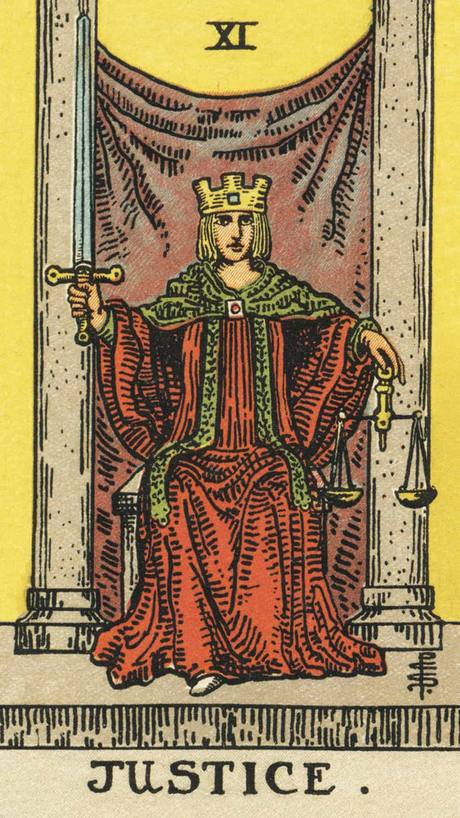
A seated figure holds scales in one hand and an upright sword in the other, framed by pillars and a hanging cloth. The scales evoke careful weighing, while the sword suggests a decision made with clarity. The seated posture gives the scene a measured quality.
What to Notice
The scales and sword work together. What needs weighing before you decide, and what needs a clear conclusion after you have done so?
Understanding the Meaning
Core Symbolism
Use the same standard when assessing your choices and those of others.
Upright, Justice points toward fairness, truthful assessment, and the consequences of a decision. It may ask you to examine an agreement, correct an imbalance, or acknowledge a responsibility.
A fair judgment requires adequate information and a chance to hear relevant perspectives. The card can frame these questions but does not establish the outcome of a formal dispute.
A Reflective Perspective
Consider whether you are seeking understanding, vindication, or punishment. These aims lead to different actions. Separating them can make it easier to identify what would actually repair the situation.
Questions to Consider
- What information supports my conclusion?
- Am I applying a consistent standard?
- What responsibility or repair is within my control?
Everyday Guidance
Love & Relationships
Describe the specific imbalance rather than presenting a total judgment of the relationship. Discuss a fairer arrangement and acknowledge where your own behavior needs changing. Allow both people to explain their experience.
Career & Work
Read important agreements carefully and clarify unclear responsibilities. Use explicit criteria when evaluating work. For formal legal or contractual decisions, obtain the relevant information and qualified advice rather than treating a reading as a verdict.
Personal Growth
Choose one action that brings your behavior closer to your values. If you made a mistake, identify the consequence and a practical repair. Avoid replacing accountability with prolonged self-punishment.
Reversed Meaning
Reversed, Justice may reveal uneven standards, missing information, or responsibility that has been avoided.
Bias
A preferred conclusion may be shaping which facts you notice.
Unequal treatment
An agreement may need a more balanced distribution of responsibility.
Incomplete information
Delay a strong judgment until key details are clarified.
Avoided accountability
Recognize the part you can acknowledge and repair.
Advice for Your Reading
Clarify the facts and choose a proportionate response.
Look for the fairest next step available with the information you have. A clear question, corrected agreement, or acknowledged mistake may be more useful than deciding who is entirely right.
Explore Your Own Tarot Reading
Bring your question to a personal reading.