
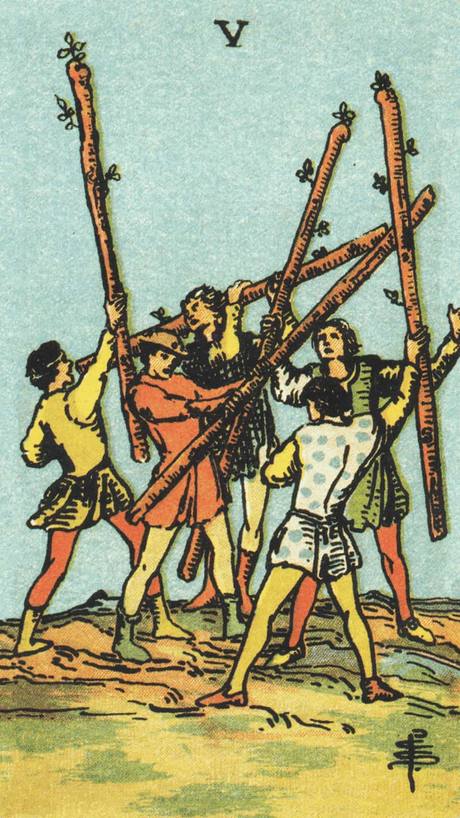
Five of Wands
Competing interests, Friction, Debate.
The Five of Wands explores friction among different energies, aims, or methods. It asks whether a disagreement can become useful learning and what coordination is needed to prevent effort from turning into needless struggle.
Upright Keywords
Reversed Keywords
Meanings at a Glance

Love & Relationships 
Differences may be creating tension without a shared way to discuss them. Focus on the actual issue and avoid turning every disagreement into a contest of who matters more.

Career & Work
Competing ideas or unclear roles may be slowing a team. A defined purpose and fair discussion can turn friction into a more useful exchange.

Personal Growth
Notice how you respond to comparison or challenge. Practice can build confidence when you do not treat every difference as a threat.
Five of Wands: A Deeper Reading
Card Imagery & Symbolism
Five figures hold raised wands in a crowded arrangement. Their movements appear energetic but poorly coordinated. The scene can suggest competition, practice, or disagreement, with the meaning shaped by how the participants use their effort.
What to Notice
The figures have energy but no obvious shared direction. What would help everyone understand the purpose of the interaction?
Understanding the Meaning
Core Symbolism
Give disagreement a useful purpose and a workable form.
Upright, the Five of Wands highlights competing interests, active challenge, or the friction of working with different approaches. Conflict may reveal information that a surface agreement concealed.
The task is to assess its usefulness. Debate supports progress when participants can hear each other and work toward a defined outcome.
A Reflective Perspective
Consider whether disagreement makes you defensive, silent, or overly competitive. Naming your response can help you stay involved without losing sight of the actual question.
Questions to Consider
- What are we actually disagreeing about?
- Which aim do we share?
- What rule would make this discussion more productive?
Everyday Guidance
Love & Relationships
Discuss one issue at a time. Let each person describe the concern without interruption, then identify a possible adjustment. Avoid introducing unrelated grievances merely to gain an advantage.
Career & Work
Clarify the decision to be made and who owns it. Compare ideas against agreed criteria. Distinguish healthy challenge from a process where participants compete for attention without improving the work.
Personal Growth
Use a challenge to identify a skill worth practicing. Reduce comparison that leaves you discouraged without teaching you anything. Seek feedback focused on behavior and technique.
Reversed Meaning
Reversed, the Five may indicate conflict being suppressed, becoming exhausting, or moving toward resolution. A quieter interaction is not enough to tell these apart: check whether the issue has been discussed and a workable agreement is being used, or whether people have simply stopped raising it.
Avoided disagreement
An unresolved issue may be kept beneath polite interaction. Notice whether people can name the disagreement and discuss it, rather than assuming the absence of argument means their concerns have been addressed.
Unproductive rivalry
Competition may be consuming more energy than it contributes.
Possible resolution
A clearer shared purpose may allow tension to ease. Look for an agreed way to handle the issue and follow-through on that agreement, while allowing time to see whether it works.
Advice for Your Reading
Turn the contest into a conversation about the actual task.
Identify what the friction is revealing and what outcome would make the exchange worthwhile. If no useful purpose remains, choose a boundary or a different process.
Explore Your Own Tarot Reading
Bring your question to a personal reading.