
Five of Swords
Conflict, Costly victory, Self-interest.
The Five of Swords asks what a conflict is costing and whether winning the immediate exchange serves the wider relationship or goal. It invites attention to trust, consequences, and the possibility of a more proportionate response.
Upright Keywords
Reversed Keywords
Meanings at a Glance

Love & Relationships 
An argument may be leaving one or both people unheard. Consider whether the aim is understanding or securing a victory at the connection's expense.

Career & Work
Competition or a dispute may undermine cooperation. Assess the result alongside its effects on trust, participation, and future work.

Personal Growth
Notice what happens when you feel you must win. A boundary or withdrawal from an unproductive contest may protect more than another argument.
Five of Swords: A Deeper Reading
Card Imagery & Symbolism
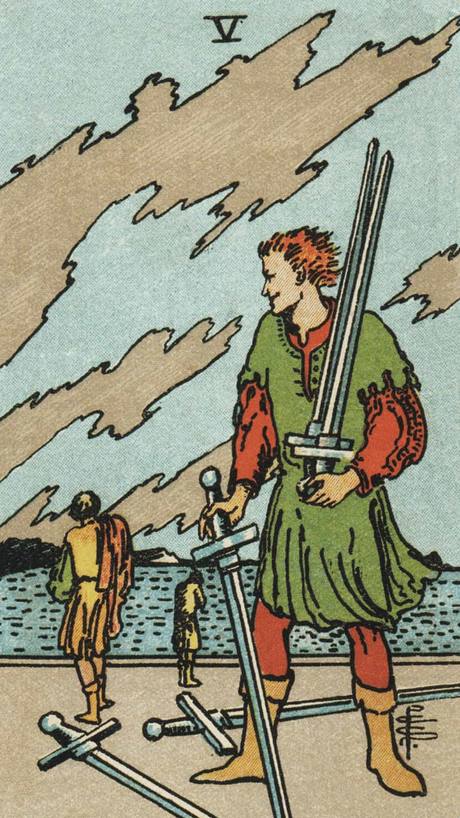
One figure gathers swords while two others walk away beneath a troubled sky. The separation between them suggests a contest with consequences beyond the immediate result. The gathered weapons do not reveal whether the apparent winner has preserved connection.
What to Notice
The others are leaving. What may be lost even if one position prevails?
Understanding the Meaning
Core Symbolism
Assess the cost of the contest before continuing it.
Upright, the Five of Swords highlights conflict, self-interest, or a result that comes at a substantial relational cost. It asks you to examine how the exchange is being conducted.
You may need a firm boundary, a changed process, or an acknowledgment of harm. Not every dispute can be repaired through further debate.
A Reflective Perspective
Consider whether being challenged feels like losing your standing. That response can make a disagreement larger than the issue itself. Focus on the consequence you actually want to improve.
Questions to Consider
- What would winning this exchange cost?
- What outcome is actually useful?
- Do I need repair, a boundary, or a different process?
Everyday Guidance
Love & Relationships
Stop repeating a conversation that becomes humiliating or hostile. Name the issue and the behavior that needs to change. A repair requires acknowledgment and different actions, not simply ending the argument.
Career & Work
Clarify the shared goal and use a fair decision process. Record agreements if trust has weakened. Avoid tactics that secure short-term advantage by making future collaboration less workable.
Personal Growth
Reflect on a conflict without assigning all responsibility to one side automatically. Identify your part and your limit. Choose one action that reduces further harm or supports appropriate repair.
Reversed Meaning
Reversed, the Five may suggest willingness to repair or resentment that remains beneath an apparent resolution.
Possible repair
Acknowledgment may create room for a different exchange. Look for an honest account of the impact and a change in the behavior that caused it. An apology or a quieter conversation can begin repair, but does not by itself show that trust has been restored.
Lingering resentment
Ending the argument may not have addressed its impact.
Useful withdrawal
Leaving an unproductive contest can protect your priorities.
Advice for Your Reading
Choose the response that preserves what still matters.
Look beyond the immediate score of the disagreement. A clear limit or honest repair can serve your longer-term aim better than another attempt to prevail.
Explore Your Own Tarot Reading
Bring your question to a personal reading.